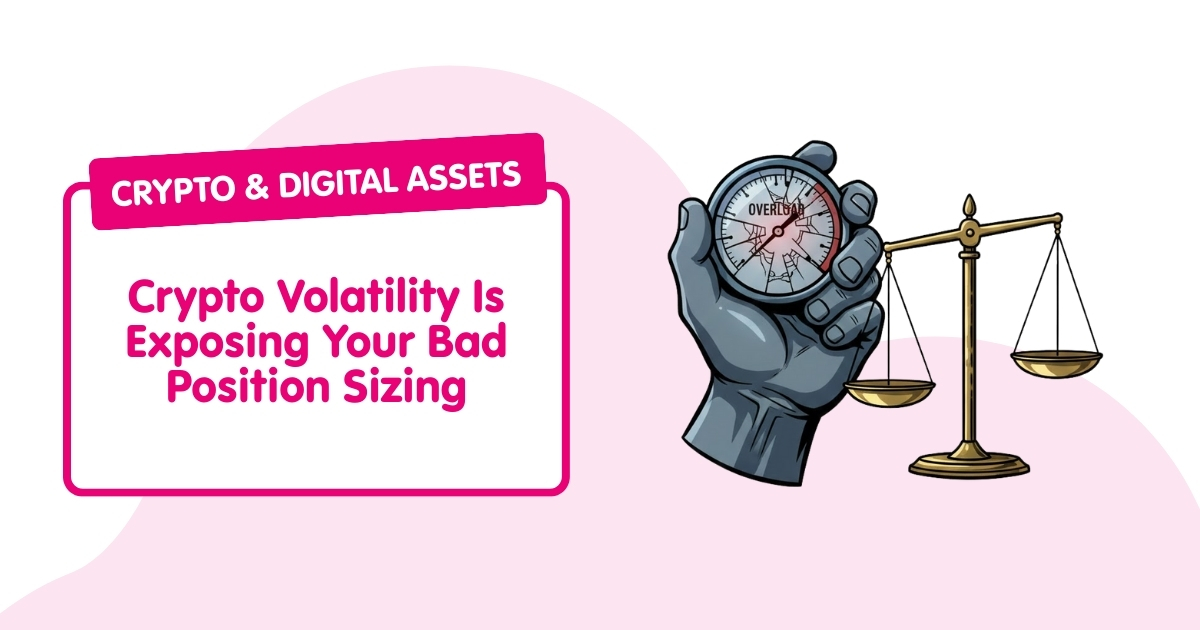
Most traders say volatility is the reason their crypto trades fail. It moves too fast, spreads widen, stops get hit, and accounts swing wildly. That explanation feels reasonable and external. It also keeps you from looking at the one decision that actually determines whether volatility hurts you or not.
This article is not about calming yourself during wild markets. It is about understanding why the same volatility wipes out one trader and barely affects another. The difference is not strategy, prediction skill, or market timing. It is position size, chosen quietly before the trade and rarely examined honestly afterward.
Crypto volatility does not destroy accounts by itself. It magnifies sizing mistakes that were already there. If that sounds uncomfortable, it should. Volatility is not the enemy. It is the spotlight.
Why volatility feels like the cause
Volatility feels violent because it compresses time. Moves that would take days elsewhere happen in hours. That speed creates stress and urgency, which makes losses feel sudden and unfair. When price moves quickly against you, it is natural to blame the environment rather than the exposure you chose.
But volatility is not directional. It does not decide who wins or loses. It simply increases the range of outcomes. If volatility were the problem, everyone trading the same market would suffer equally. That never happens.
Some traders reduce risk when conditions change. Others increase it, consciously or not. Volatility reveals those differences quickly. What feels like market chaos is often just math catching up.
The exposure decision you already made
Every trade starts with a number, even if you never write it down. That number is how much of your account you are willing to lose if you are wrong. Everything else is secondary.
In low volatility markets, poor sizing can go unnoticed. Price drifts slowly, stops survive longer, and mistakes take time to matter. In crypto, that grace period does not exist. Normal movement is large enough to test your assumptions immediately.
If a standard price swing threatens your account, the problem is not the swing. It is that your position could not survive normal conditions.
Why tight stops and large size collide
A common response to volatility is to tighten stops. The logic seems sound. If price moves fast, exit faster. The flaw is that tight stops increase the probability of being wrong, especially in markets that breathe widely.
When you combine tight stops with large position size, you create a fragile structure. Price does not need to invalidate your idea. It only needs to move normally. Each stop out feels unlucky, but the pattern is structural.
This is why traders experience clusters of losses during volatile periods. The market did not suddenly become hostile. Their sizing assumptions stopped matching reality.
Leverage makes the mistake louder
Leverage is often blamed as the villain in crypto trading. In truth, leverage is neutral. It does not create losses. It amplifies the consequences of decisions.
High leverage paired with oversized positions leaves no room for error. Small adverse moves become existential threats. Margin pressure forces exits before the trade has time to work.
When traders say volatility caused a margin call, what they mean is that leverage removed their tolerance for normal movement. The mistake happened at entry, not at liquidation.
[ADS]
The drawdown math most traders avoid
Losses do not scale linearly. A ten percent drawdown requires more than ten percent to recover. A thirty percent drawdown requires over forty percent. At fifty percent, recovery demands perfection.
Oversized positions accelerate this curve. Volatility supplies speed, but size supplies damage. This is why traders feel trapped after a few bad days. They are not unlucky. They are fighting compounding math.
Smaller size does not eliminate losses. It keeps them shallow enough to recover from. That difference determines whether a trader continues or quits.
Why conviction is the wrong sizing input
Many traders size positions based on confidence. They believe strongly in an idea, so they risk more. This feels rational but fails under scrutiny.
Conviction is subjective and unstable. It fluctuates with recent wins, losses, and narratives. Volatility does not care about your confidence. It only interacts with exposure.
Professional traders size based on what the market can do against them while the idea remains valid. That approach is unemotional and adaptive. It accepts uncertainty instead of trying to overpower it.
The quiet benefit of smaller size
Reducing position size does more than protect capital. It changes behavior. When losses are tolerable, traders stop reacting impulsively. They wait, observe, and execute plans more consistently.
This behavioral shift is subtle but critical. Many strategy problems disappear when size is reduced. What looked like poor timing was actually emotional interference caused by oversized risk.
Smaller size does not feel exciting. It feels boring. That boredom is often mistaken for inefficiency. In reality, it is stability.
Why crypto magnifies this mistake
Crypto markets trade continuously. There are no session breaks, no quiet periods guaranteed, no pauses for reassessment. Price moves while you sleep, while you work, while you are distracted.
This constant exposure punishes oversized positions. You cannot rely on timing alone. Your size must assume you will not be present for every move.
Traders who treat crypto like slower markets learn this lesson the hard way. Volatility does not wait for permission.
[ADS]
The incentive mismatch traders ignore
Most traders say they want consistency. Their behavior suggests they want stimulation. Large positions provide stimulation. They also create stress, mistakes, and short careers.
Volatility becomes the excuse that justifies this mismatch. It feels noble to battle a wild market. It feels less comfortable to admit impatience.
Until incentives change, behavior stays the same. Volatility will continue to expose that gap.
What alignment actually looks like
Alignment means sizing positions so that normal movement does not force emotional decisions. It means accepting lower short term returns in exchange for durability.
This approach is not flashy. It does not produce dramatic screenshots. It produces longevity.
Traders who survive volatile markets do not predict better. They tolerate better.
A quieter conclusion
Volatility will remain part of crypto markets. It is not a temporary phase. Complaining about it changes nothing.
What changes outcomes is how much of your account is exposed when volatility arrives. That decision is made before the trade, not during the chaos.
Most traders never adjust. They keep trading as if the environment owes them smoother outcomes. It does not.
The question is not whether crypto is volatile. The question is whether your position size respects that reality.
Leave a Reply