Most forex losses do not start when you click buy or sell. They start earlier, when you decide what to trade, when you decide when to trade it, and when you decide what story you are going to tell yourself about the context.
If that sounds like semantics, look at your own habits. You can spend an hour refining an entry trigger and spend five seconds choosing the pair. Then you act surprised when the trade feels erratic, spreads feel predatory, and price behaves like it is personally offended by your stop. It is not personal. You walked into the wrong room at the wrong time and blamed the door handle.
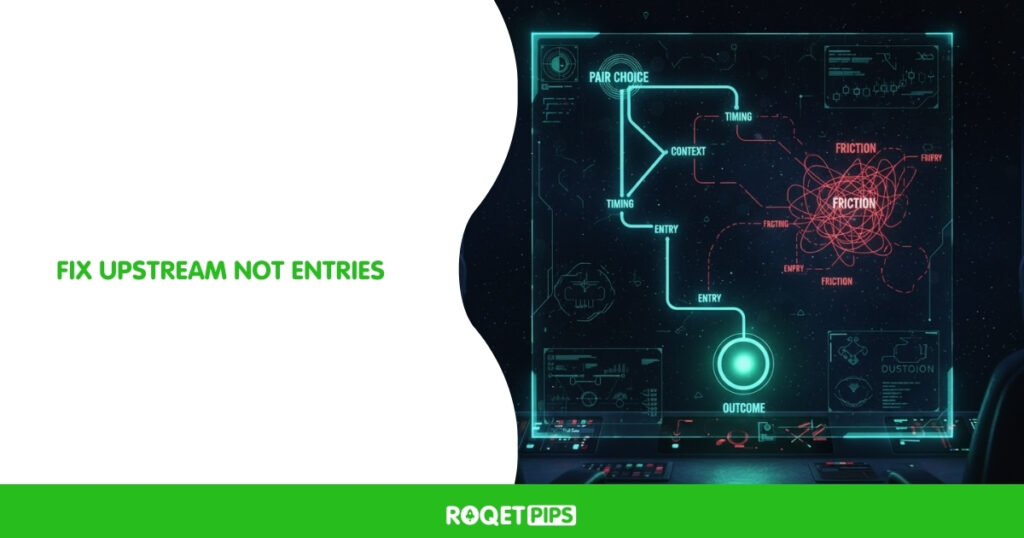
This is uncomfortable because it shifts responsibility away from your entry tool and back onto your decision process. Entries are the last five percent. Pair selection, timing, and context are the first ninety five.
The entry obsession is a coping mechanism
The retail trading world loves entries because entries feel controllable. You can circle candles, define patterns, and argue about confirmations. It creates the impression that precision equals skill.
The problem is that entries are often where traders hide from the real work. If you are constantly changing your trigger, you never have to admit you keep trading garbage conditions. You never have to admit you chose the pair because it was moving. You never have to admit you traded the London open like it is a law of nature instead of a session with specific liquidity dynamics.
A clean entry in a bad context is still a bad trade. It just fails more slowly and teaches you the wrong lesson.
Pair selection is not a preference, it is an exposure choice
Pairs are not interchangeable. They carry different volatility profiles, different sensitivity to macro drivers, and different liquidity characteristics across sessions. Picking a pair is picking what kind of randomness you are willing to deal with.
Many losses that get blamed on bad analysis are simply a mismatch between the trader and the pair. A trader who needs smooth movement trades a pair that spikes on headlines. A trader who uses tight stops trades a pair that routinely wicks beyond obvious levels. Then they call it stop hunting and move on.
You cannot trade every pair the same way and pretend you are being versatile. You are being careless.
Timing is not about clock time, it is about liquidity conditions
People talk about sessions as if they are time slots. Asia, London, New York. That framing is too shallow. Sessions are liquidity environments. They change how price moves and how clean your signals are.
A breakout strategy during a high liquidity overlap can behave like a different strategy during a thin holiday session. The setup might look identical. The fill, the follow through, and the failure mode will not.
This is why traders can backtest something that looks decent and then watch it disintegrate live. Their backtest did not capture the reality of when they actually trade. They tested patterns. They did not test conditions.
Context is the part you keep skipping because it is harder to fake
Context forces you to think in ranges, narratives, and constraints. It forces you to admit when the market is not offering your edge. That is the moment most traders panic, because no trade feels like failure.
So they manufacture one. They take the same setup inside a congested range, during a low liquidity period, against a strong higher timeframe move, and call it aggressive. Then they act shocked when it chops them up.
Context is not an extra. It is the filter that decides whether your entry even has a chance.
The hidden pre trade checklist you already use badly
Most traders do have a pre trade checklist. It is just unconscious and sloppy.
It usually looks like this. Is it moving. Do I feel like trading. Does the chart look clean enough. Did I miss a move earlier. Can I make something happen before I log off.
None of that is analysis. It is impulse dressed up as process.
A real pre trade filter is boring. It asks questions you do not want to answer because the honest answer often means no trade. Which pair is most liquid right now. What is the spread relative to the stop. Is the pair reacting to a scheduled driver today. Are we in expansion or compression. Is this move happening in the middle of a range or at an edge.
If your process does not start there, you are entering trades that were dead on arrival.
[ADS]
Most losses are just friction costs you volunteered to pay
Spreads, slippage, and random wicks are not always manipulation. Often they are the cost of trading something at the wrong time. If you trade exotic or illiquid pairs, you are agreeing to higher friction. If you trade during thin conditions, you are agreeing to worse fills. If you trade right before high impact data, you are agreeing to chaos.
Then you get angry when the bill shows up.
This is a hard truth because it removes the villain. It means you were not unlucky. You were careless with the environment.
Pair selection mistakes usually come from identity, not logic
Some traders trade pairs because they want to feel like a certain kind of trader. They trade GBP pairs because they want speed. They trade exotic pairs because they want uniqueness. They trade whatever is trending on social media because they want relevance.
That is not a market decision. It is identity management.
If you want results, you have to trade like a boring professional. Choose pairs you can understand, pairs you can execute, and pairs that match the style of edge you actually have.
Timing mistakes usually come from impatience
Many traders know the market is choppy and trade anyway. They know liquidity is low and trade anyway. They know they are tired and trade anyway.
They do it because waiting feels like losing. The market rewards patience less often than it punishes impatience, but the punishment is sharper and more memorable.
Timing is not a nice to have. It is the difference between trading a signal and trading noise.
What context actually looks like in practice
Context is not a vague idea. It is a set of constraints.
Are you trading with or against the higher timeframe flow. Are you near a level where the market has already shown strong reactions. Are you in the middle of a range where both sides are getting filled and dumped repeatedly. Is today driven by a central bank event or a quiet calendar.
You do not need a complex macro model. You need to stop pretending every hour is equal. Forex is not a static environment. It changes all day.
The myth that you can trade anything if your entry is sharp
A popular belief is that a good enough entry can make any situation tradable. It is the same fantasy as thinking good reflexes make bad driving safe.
In reality, sharp entries are most useful when everything else is aligned. They help you reduce risk, improve expectancy, and avoid unnecessary drawdown. In bad context, they simply help you lose more efficiently.
If your strategy relies on perfect timing to survive, it is fragile. And fragile strategies are the ones that break the moment spreads widen or volatility shifts.
[ADS]
Why this problem is worse in forex than people admit
Forex is marketed as liquid and stable. Compared to many assets, it often is. That marketing creates overconfidence. Traders assume they can scalp tight stops on anything, at any time, and execution will behave.
Reality is more conditional. Liquidity concentrates in specific sessions. Certain pairs are clean only during certain windows. Some pairs are heavily driven by rate expectations and macro shifts even when the chart looks calm.
When traders ignore this, they run strategies that depend on ideal conditions, and then they blame themselves for failing to execute. The system was not designed for the environment they actually trade.
A simple diagnostic that catches most of this
If you want to know whether you are losing before entry, look at your last twenty losing trades and categorize them.
How many were taken in the middle of ranges. How many were taken during low liquidity times. How many were taken on pairs you do not track consistently. How many were taken right before major scheduled events. How many were taken because you were bored.
If your honest answer is more than a few, your entry logic is not the core issue. Your decision filter is.
The uncomfortable part you will resist
You probably trade too many pairs. Or you trade the wrong ones. Or you trade good pairs at the wrong times. Or you ignore context because it forces you to do less.
This is where most traders protect their ego. They would rather believe the market is unpredictable than admit they are undisciplined in their selection process. Unpredictable markets absolve you. Bad selection exposes you.
If you want to improve, stop trying to be clever at the point of entry and start being strict before you even look for one.
What a real pre trade filter looks like
A useful filter does not try to predict. It tries to remove low quality situations.
Pick a small set of pairs you can actually learn. Know when they trade clean and when they do not. Avoid hours where spreads widen and follow through collapses. Respect days where scheduled events can distort everything.
Then apply your entry logic inside that narrower world. Your entries will start working better without changing the entry rules, because you stopped forcing them into bad environments.
This is the part traders hate because it reduces activity. It also reduces losses.
Why this is a forex education problem, not a talent problem
Retail traders are taught patterns and indicators first. They are rarely taught selection and environment. The result is predictable. They become good at spotting setups and terrible at choosing when a setup matters.
Talent is not the bottleneck. Process is.
A trader who learns to filter pairs, timing, and context early can often outperform a technically sharper trader who refuses to do that work. The second trader is always reacting. The first trader is choosing.
[ADS]
The quiet conclusion nobody wants
If most of your losses happen before entry, the fix is simple and annoying. You do not need a new indicator. You need fewer markets, fewer hours, and fewer excuses.
That does not mean trading becomes easy. It means your losses become more honest. You will lose on real uncertainty instead of losing on avoidable noise.
If you start losing after you enter, at least you were trading something worth trading. Right now, a lot of traders are paying tuition for decisions they could have prevented in the first ten seconds.
Leave a Reply